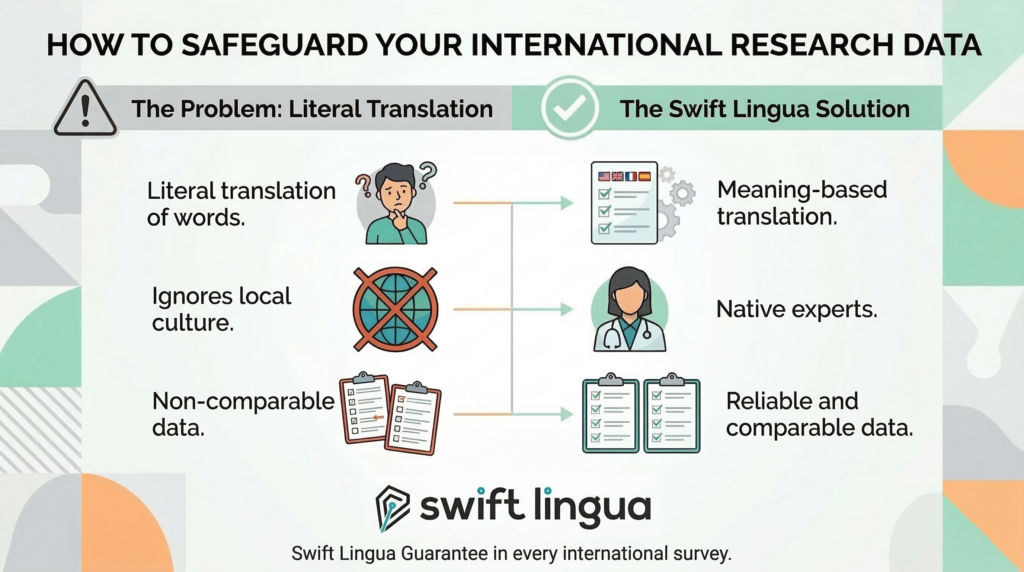
The Hidden Cost of Literal Translation
In the global economy, brands no longer test products solely in their local market. They design multi-country quantitative studies to capture the voice of the consumer on a large scale. However, in the methodological design of these investigations, a critical factor is often overlooked—one that can invalidate months of work and thousands of pounds in investment: the translation quality of the questionnaire.
Many research agencies treat linguistic adaptation as the final administrative hurdle of the process, opting for quick fixes or generalist agencies. The result is devastating: a literal translation that destroys data reliability.
1. The Trap of Rating Scales (Likert)
Imagine a global satisfaction study. The original English questionnaire uses the standard scale: “Strongly Agree” and “Somewhat Agree”.
If you translate these options literally into ten different languages without considering the cultural and idiomatic weight, you are introducing a systematic linguistic bias.
For example, in certain Asian cultures, the direct expression of extreme disagreement is less common. If the translation of “Strongly Disagree” sounds too aggressive or unnatural, respondents will tend to avoid that option—not because they agree with the product, but because the language of the question makes them uncomfortable.
The result? Your quantitative analysis will show a false positive trend. You will be making strategic decisions based on the noise generated by a poor translation, rather than the true sentiments of the consumer.
2. Don’t Translate Words: Localise the Cognitive Intent
The goal of an international survey is not for the words to be identical in every language. The real objective is to provoke exactly the same cognitive reaction in a consumer in Tokyo, Berlin, or Madrid as in the original consumer in London.
This requires much more than bilingualism. It requires specialised linguists in market research who truly understand survey methodology. The following must be evaluated:
- Naturalness: Is this a common way to ask this in the target market?
- Emotional intensity: Does this response option convey the exact same degree of agreement/disagreement as the original?
- Cultural load: Does the question assume cultural contexts that do not exist in the target country?
When literalness is forced, equivalence is broken. And when equivalence is broken, international data ceases to be comparable.
3. Linguistic Quality as Life Insurance for Your Data
A translation error in a marketing brochure is embarrassing. A translation error in a quantitative questionnaire is incredibly costly.
If your data is tainted by linguistic bias, all subsequent statistical analysis loses its rigour. Outliers multiply, and key findings are diluted. It is a wasted investment that can lead to flawed conclusions about a market’s potential or a product’s acceptance.
In the B2B market research sector, precision is not a luxury; it is the very foundation of the credibility of the agency delivering the report.
Safeguard the Integrity of Your Next Study with Swift Lingua
At Swift Lingua, we don’t just “switch questionnaires from one language to another”. We specialise in protecting the scientific integrity of your international studies.
We rely on teams of native linguists specifically trained in market research methodology. They understand how a rating scale works and how to adapt complex questions so they sound 100% natural, ensuring that your international findings are robust, reliable, and, above all, free from cultural bias.
Don’t let the invisible enemy ruin your investment. Linguistic quality is the only guarantee of your data’s quality.
Are you planning a multi-country study? Speak with our specialists at Swift Lingua today and discover how to safeguard your data quality from the very first question.
🔗 Request a quote for survey translation!