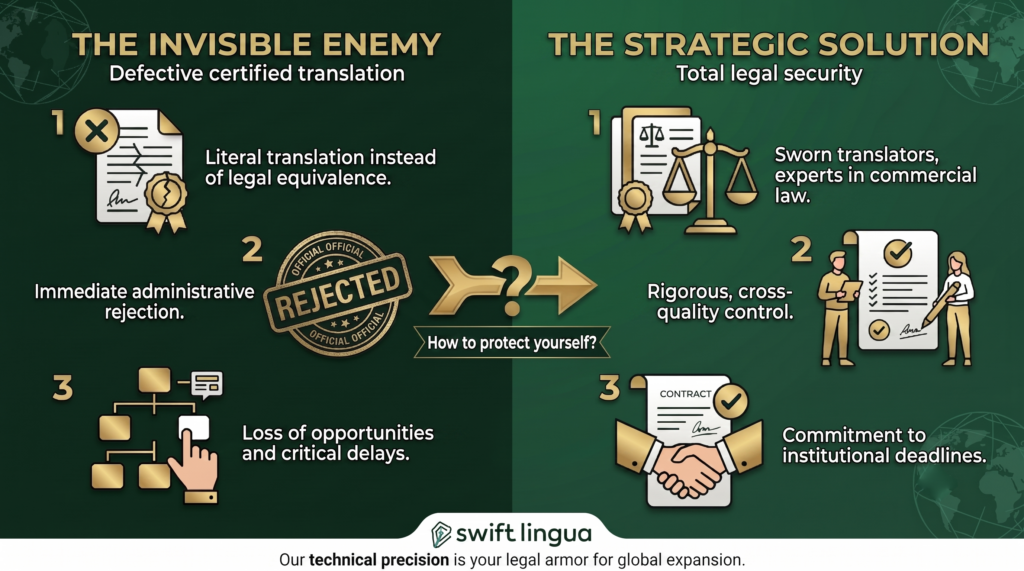
The international expansion of a company is a strategic milestone that demands meticulous planning. Months are invested in market research, commercial strategies, and financial projections. However, there is an invisible enemy within the regulatory environment capable of ruining all this effort in a matter of seconds: a defective certified translation. When an organisation presents corporate documentation to foreign official bodies, commercial registries, or courts, linguistic precision ceases to be a mere formal courtesy and becomes an absolute legal imperative.
The true risk in legal translation does not lie in spelling, but in comparative law. A translator without the appropriate qualifications may make the mistake of translating words literally instead of analysing and finding the exact equivalent in the destination legal system. This lack of technical precision is the primary reason why a foreign administration might instantly reject an entire corporate dossier.
The Impact of Imprecision on Key Corporate Documents
The most critical errors typically cluster around a very defined group of essential documents required for any internationalisation programme:
- Articles of Association and Shareholder Agreements: A misinterpretation of the corporate purpose or share capital structure can completely invalidate the recognition of the company before international notaries.
- Powers of Attorney: Confusing the terms of delegated authority can legally disqualify company directors from signing contracts or opening overseas subsidiaries.
- Annual Financial Statements and Audit Reports: Disparities in international financial nomenclature can raise compliance red flags, triggering unforeseen tax audits.
- Tender Specifications for Public Procurement: A technical flaw in the certified translation of quality compliance certificates results in automatic disqualification from the tender.
The consequences of these institutional failures are not restricted to the financial cost of re-processing the paperwork. The true danger is the opportunity cost: cross-border mergers stalled at the notary, commercial penalties due to missed deadlines, and the loss of multi-million-pound contracts to competitors who met the regulatory requirements at the first attempt.
The Strategic Solution: How Does Swift Lingua Safeguard Your Legal Security?
At Swift Lingua, we understand that a certified translation is not a simple administrative task, but a critical asset within your expansion’s risk management strategy. To mitigate these regulatory hazards, we have designed a highly rigorous workflow:
- Native and Specialised Certified Translators: We possess a network of officially accredited professional translators who not only master the linguistic combination but are also qualified experts.
- Cross-Checked Quality Assurance: Every legal document undergoes a strict review by a second legal linguist, ensuring there are no terminological gaps or formatting discrepancies.
- Alignment with Institutional Deadlines: We synchronise our processes with your regulatory schedule, ensuring flawless deliveries that eliminate the risk of administrative bottlenecks.
Successful internationalisation requires partners who speak the language of business and law fluently. Do not allow bureaucracy to paralyse your global growth; entrust your documentation to expert hands.